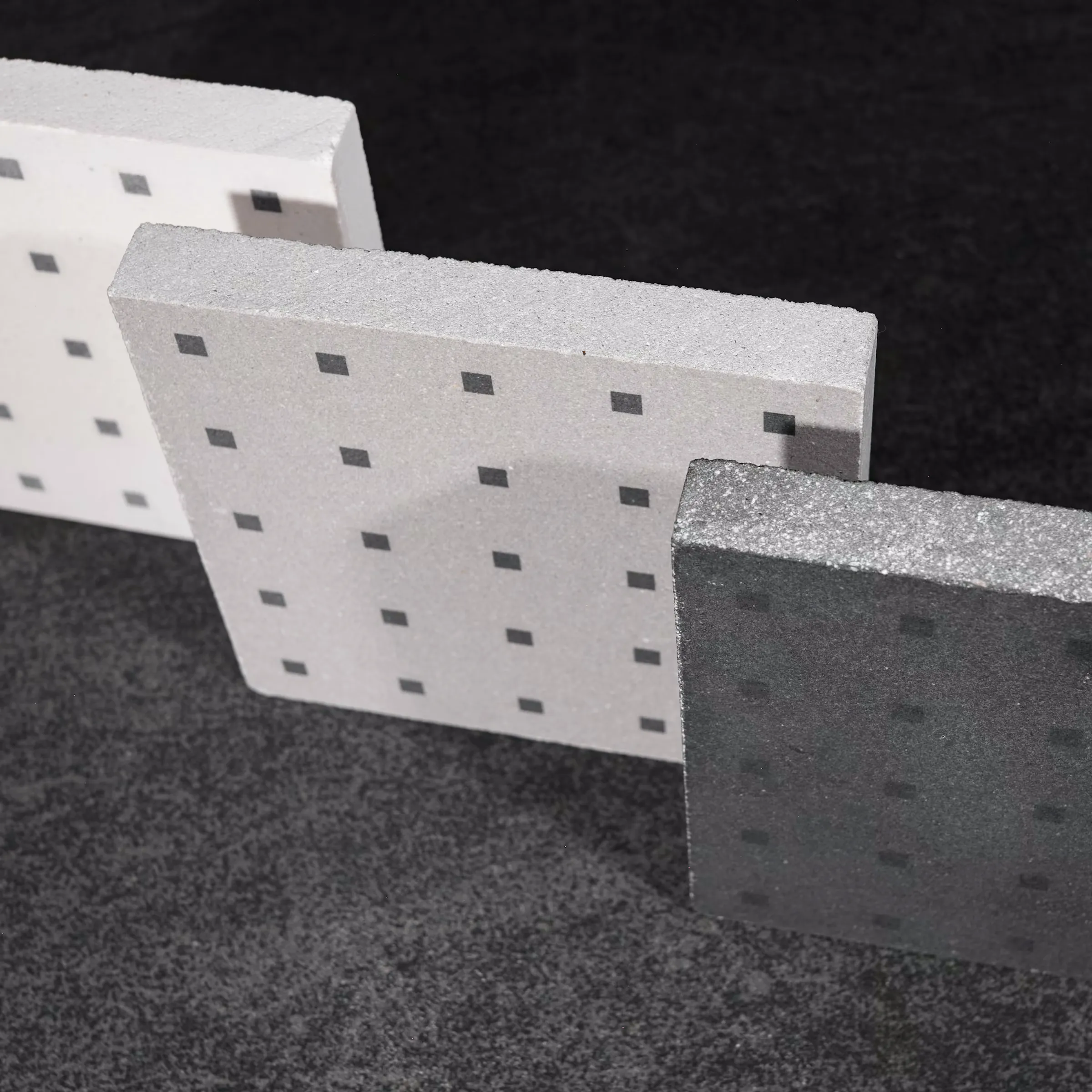
Cement Tiles
Cement tiles for floor and wall. The evolution of traditional cement tiles, developed with a thinner profile and low water absorption for architecture and interior design projects. A technical cement alternative to ceramic imitations.
The evolution of cement tiles
Cement tiles originated in the 19th century as pigmented tiles pressed using a hydraulic press. Manufactured without kiln firing, they soon became a defining feature of Modernist and Mediterranean architecture, valued for their durability, decorative richness and handcrafted character.
Our cement tiles reinterpret this mineral heritage through a proprietary manufacturing process that improves stability, reduces thickness and preserves the authenticity of cement. Alongside traditional patterns, we have developed contemporary designs that integrate naturally into both classic interiors and modern architecture and interior design projects.
Inspired by the tradition of hydraulic presses, our system overcomes the main limitations of traditional encaustic tiles by reducing porosity and thickness, thereby expanding their possibilities for both floor and wall applications.
The tiles retain the same mineral composition and manufacturing principles as traditional cement tiles, but feature a single-layer structure. They are cold-pressed without kiln firing, ensuring authenticity and material consistency.
Our cement tiles are available in 15×15, 10×20 and 20×20 cm formats, with collections ranging from traditional geometric patterns to contemporary designs for floors and walls.
Architecture and Interior Design
Our tiles are different from ceramic tiles and porcelain stoneware. They are made entirely from the same mineral material, so the surface and the body share a uniform composition. This opens up new creative possibilities for architecture, interior design and outdoor spaces.
Traditionally, cement tiles have been associated with classically inspired ornamental motifs. Our concept preserves this aesthetic heritage while projecting it into the present through geometric patterns, contemporary compositions, and bespoke collections. The result is a fresh interpretation of this material, equally suited to traditional interiors and contemporary architectural and interior design projects.
Our manufacturing process creates a new material for floors and walls, positioned between porcelain stoneware, traditional cement tiles and natural stone. It does not imitate materials: it reinterprets them through its own substance. Not ceramic. Not stone. Material.
Concepts and ideas
Our tiles are suitable for bathrooms, kitchens, and outdoor areas, adapting perfectly to both horizontal and vertical surfaces. From continuous flooring to feature walls, they allow for the development of functional and aesthetic solutions in all types of projects using truly unique pieces:
- Modern bathroom tiles Contemporary wall and floor coverings for bathrooms
- Unique kitchen tiles Designer flooring and wall tiles for kitchens
- Non-slip outdoor tiles Slip-resistant floor tiles for exterior use
Collection catalogue
Focusing on cement as our base material, we develop floor tiles and wall tiles in a variety of finishes, ranging from smooth to textured surfaces. We incorporate protective solutions that ensure a sealed, durable material, suitable for all types of applications:
- Full catalogue Cement tiles in 15×15, 10×20, and 20×20 cm
- Cement-effect tiles Continuous surfaces with a natural concrete aesthetic
- Decorative tiles Original patterns and designer motifs
High-performance flooring
Our cement tiles provide a slip-resistant surface and excellent wear resistance, making them a durable flooring solution for both indoor and outdoor spaces. Whether used in a bathroom, kitchen or terrace, they combine the natural appearance of cement with outstanding durability.
Our material combines cement, stone and ceramic technology. Each tile is manufactured using a Sacmi press specially adapted to our production process and is available in 15×15, 10×20 and 20×20 cm formats, with natural, slightly rounded edges.
Reduced thickness for walls
Our cement tiles represent an evolution beyond conventional ceramics. With a thickness of just 13 mm and high density, they offer a finish and durability that evoke the beauty and solidity of natural stone in wall applications.
In addition, part of our manufacturing process is carried out by hand, giving every tile its own distinctive character and reinforcing our commitment to craftsmanship. This allows us to create a wall covering with an aesthetic that integrates naturally into minimalist, industrial and contemporary projects.
Cement tiles
An innovative solution for architecture and interior design projects seeking durability, continuity, and a natural aesthetic. Are you an architect or interior designer? We provide technical specifications, samples, and bespoke advice for your upcoming projects. Contact our technical team.
What sets our cement tiles apart?
We manufacture our cement tiles in Spain using a proprietary process that combines industrial innovation with an artisanal finish. Available in 15×15, 10×20, and 20×20 cm formats, they integrate the properties of ceramic, cement, and natural stone. A material with its own distinct identity for contemporary architecture and interior design.
Our technical cement tile combines the advantages of ceramic, cement, and natural stone, offering a balance of durability, aesthetics, and natural character. Consequently, our tiles are designed to create surfaces with an organic appearance, far removed from industrial uniformity.
- Versatility: suitable for floors and walls in both residential and commercial projects.
- Efficient production: formats are obtained directly from the press mould.
- High resistance: high-pressure pressing in a reduced thickness.
- Low absorption: acrylic protection that minimises porosity.
- Sustainability: manufactured without kiln firing or associated emissions.
- Touch and texture: mineral finish with a warm, natural feel.
- Unique design: natural variation between pieces as part of the process.
- Tonal variation: slight chromatic differences between pieces.
- Design depth: the colour is not surface-level; it is structural.